

Login / Register

As cybersecurity continues to evolve, professionals are increasingly seeking certifications that validate their expertise and open doors to new career opportunities. Among the most respected credentials offered by the Information Systems Audit and Control Association (ISACA) are the Certified Information Systems Auditor (CISA) and the Certified Information Security Manager (CISM). While both certifications are highly valued in the cybersecurity industry, they serve different career objectives and skill sets.
If you’re considering advancing your cybersecurity career, understanding the differences between CISA and CISM can help you choose the certification that aligns best with your professional goals.
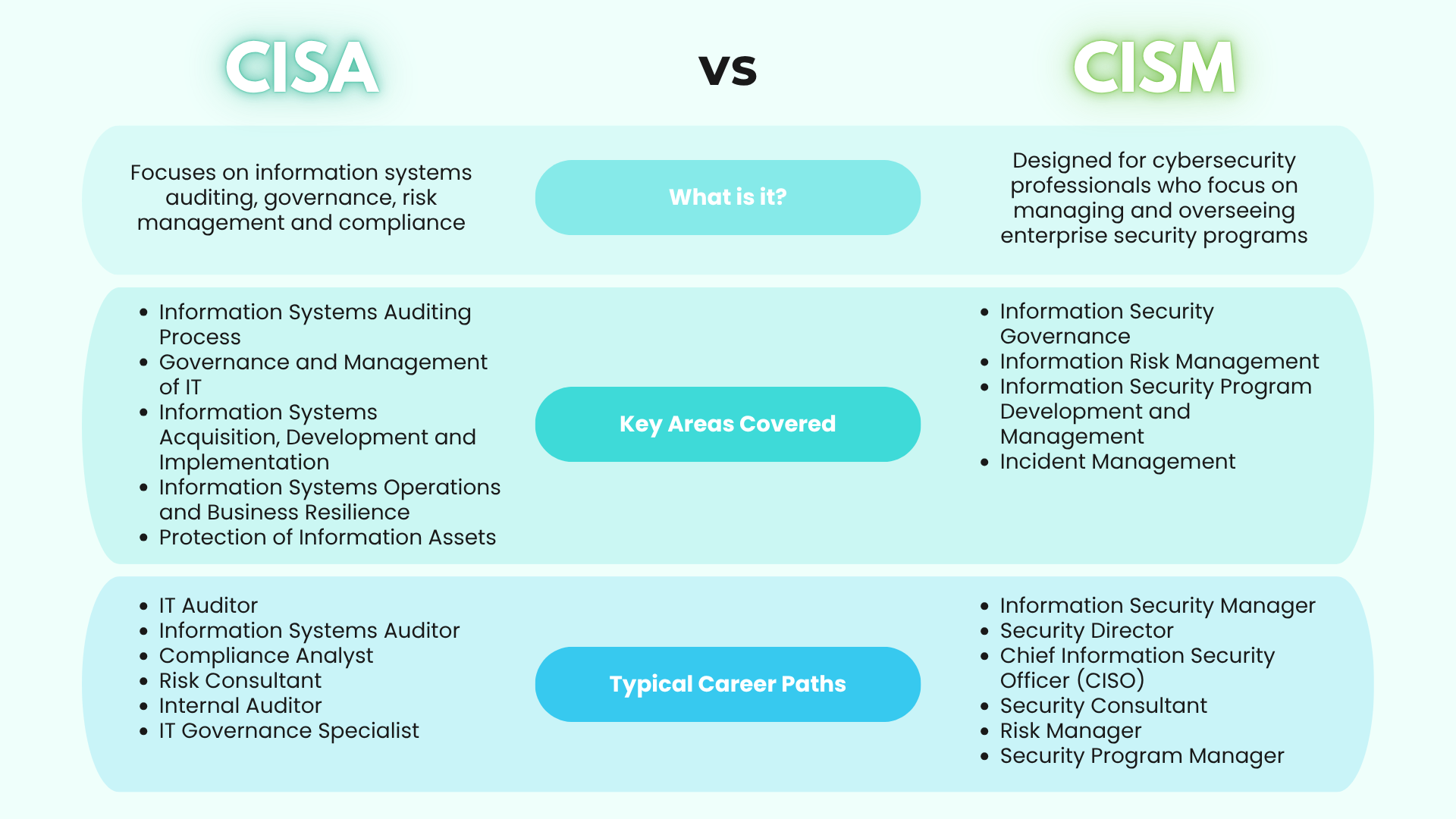
The Certified Information Systems Auditor (CISA) certification focuses on information systems auditing, governance, risk management and compliance. It is designed for professionals responsible for assessing and evaluating an organisation’s information systems and controls.
The CISM exam focuses on four primary domains:
CISM is well-suited for professionals aiming for leadership positions such as:
The certification demonstrates an individual’s ability to align security initiatives with business objectives and manage enterprise-wide security programs.
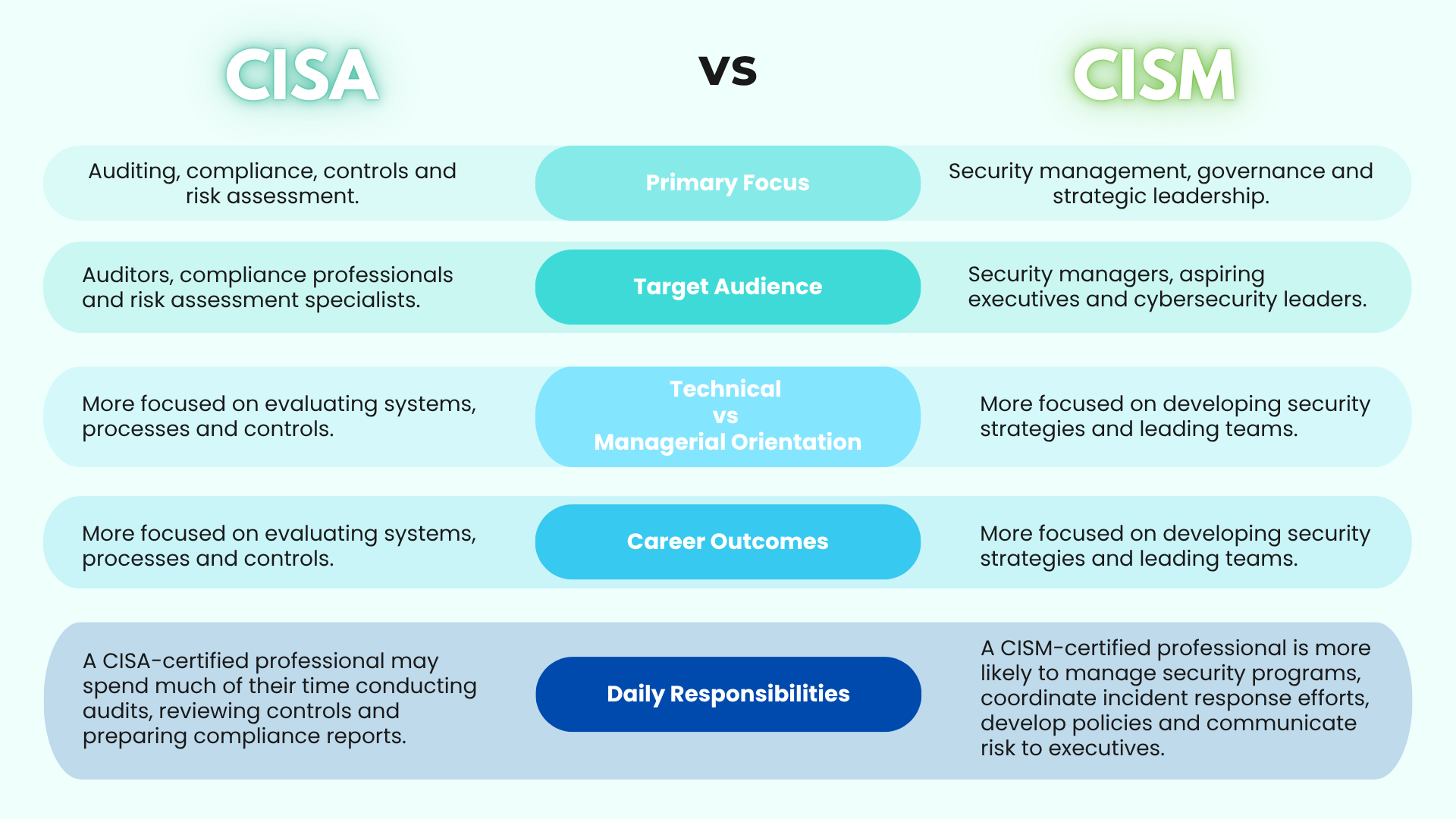
CISA: Auditing, compliance, controls and risk assessment.
CISM: Security management, governance and strategic leadership.
CISA: Auditors, compliance professionals and risk assessment specialists.
CISM: Security managers, aspiring executives and cybersecurity leaders.
CISA: More focused on evaluating systems, processes and controls.
CISM: More focused on developing security strategies and leading teams.
CISA: Often leads to auditing, governance and compliance-related roles.
CISM: Often supports progression into management and executive security positions.
CISA: A CISA-certified professional may spend much of their time conducting audits, reviewing controls and preparing compliance reports.
CISM: A CISM-certified professional is more likely to manage security programs, coordinate incident response efforts, develop policies and communicate risk to executives.
Both certifications are highly respected and frequently appear in cybersecurity job postings worldwide. Organisations facing increasing regulatory requirements value CISA-certified professionals, while companies building mature cybersecurity programs often seek CISM-certified leaders.
Salary potential depends on factors such as location, industry, experience and job title. However, both certifications are consistently associated with above-average earnings in the cybersecurity field, with CISM often commanding higher salaries due to its management-focused nature.
Both certifications require professional experience before full certification can be granted.
Candidates typically need five years of professional experience in information systems auditing, control or security-related work, though certain education and experience substitutions may apply.
Candidates generally need five years of information security experience, including management experience in specific security domains. Similar waivers and substitutions may be available.
Professionals can pass the exams before meeting all experience requirements and apply for certification once they have accumulated the necessary work experience.
The right choice depends largely on your career aspirations.
Choose CISA If You:
Choose CISM If You:

Absolutely. Many experienced cybersecurity professionals hold both CISA and CISM certifications. The combination provides a powerful blend of auditing expertise and security leadership capabilities.
For example, a professional may begin with CISA while working in auditing or risk management and later pursue CISM when transitioning into security management. Together, these credentials demonstrate a comprehensive understanding of both organisational controls and strategic security operations.
CISA and CISM are both prestigious certifications that can significantly enhance your cybersecurity career. The decision ultimately comes down to your professional interests and long-term goals. If your strengths lie in auditing, compliance and evaluating controls, CISA may be the ideal choice. If you’re aiming for security leadership, governance and management responsibilities, CISM is likely the better fit.
Before making your decision, consider where you want your career to be in the next five to ten years. Choosing the certification that aligns with your desired role can provide a clearer path toward advancement and long-term success in the cybersecurity industry.