Cybersecurity is no longer just an IT concern; it is a critical business priority. Organisations invest heavily in firewalls, endpoint protection, cloud security, Security Information and Event Management (SIEM) platforms and compliance frameworks. Yet despite these investments, many security incidents still stem from one common factor: human error and a lack of practical cybersecurity skills.
This is why hands-on cybersecurity training has become an essential part of modern cyber defence strategies. While reading documentation, watching online courses or attending presentations can improve cybersecurity awareness, these methods rarely prepare professionals for the speed, pressure and complexity of responding to real-world cyber threats.
Hands-on cybersecurity labs bridge this gap by allowing learners to practice realistic attack scenarios in a safe environment before facing an actual incident.
Knowledge vs. Practical Cybersecurity Skills
Learning cybersecurity without practical experience is like learning to drive by only reading the highway code. The theory provides a solid foundation, but confidence and competence only come from practice.
Many IT and cybersecurity professionals understand concepts such as:
- Network segmentation
- Privilege escalation
- Malware analysis
- Digital forensics
- Incident response
- Threat detection
However, during a live cyberattack, they must analyse evidence, make decisions quickly and respond accurately under pressure.
Hands-on cybersecurity labs provide a controlled environment where learners can:
- Experiment safely without affecting production systems
- Make mistakes and learn from them
- Test different investigation techniques
- Build confidence through repetition
- Develop real-world problem-solving skills
The result is a smoother transition from theoretical knowledge to practical capability.
Cybercriminals do not follow textbooks. Every attack presents unique challenges, making practical experience essential.
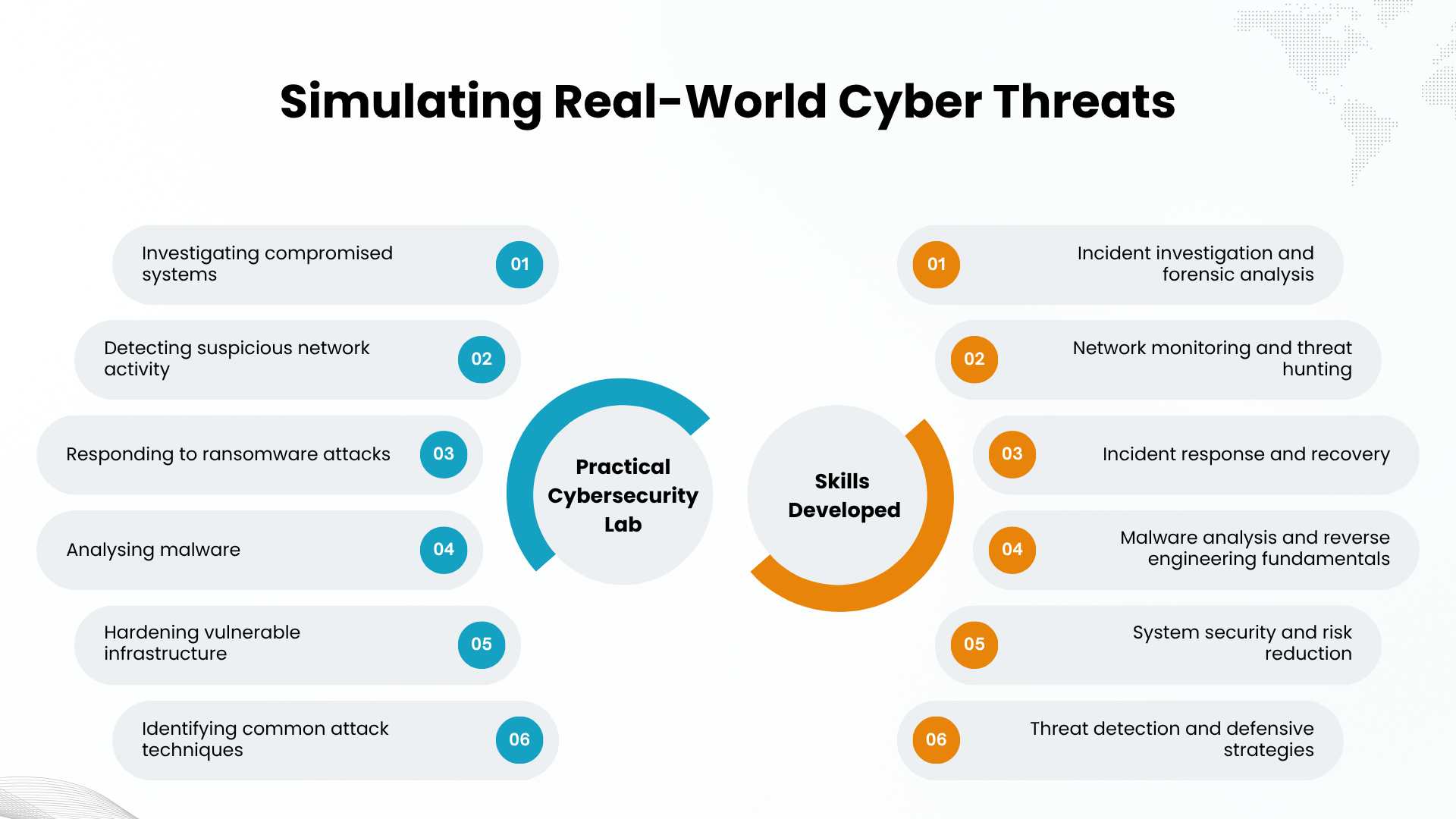
Cybersecurity labs simulate realistic scenarios that security professionals are likely to encounter in production environments.
| Practical Cybersecurity Lab | Skills Developed |
|---|---|
| Investigating compromised systems | Incident investigation and forensic analysis |
| Detecting suspicious network activity | Network monitoring and threat hunting |
| Responding to ransomware attacks | Incident response and recovery |
| Analysing malware | Malware analysis and reverse engineering fundamentals |
| Hardening vulnerable infrastructure | System security and risk reduction |
| Identifying common attack techniques | Threat detection and defensive strategies |
Experiencing these scenarios firsthand develops analytical thinking that classroom training alone cannot provide.
When employees encounter similar incidents in production, they are responding to familiar situations instead of facing them for the first time.
One of the biggest challenges during a cyber incident is often not technical knowledge, it is confidence.
Security analysts frequently have only minutes to determine whether an alert represents a genuine threat or a false positive. Delayed responses can increase business impact, while rushed decisions can create additional risks.
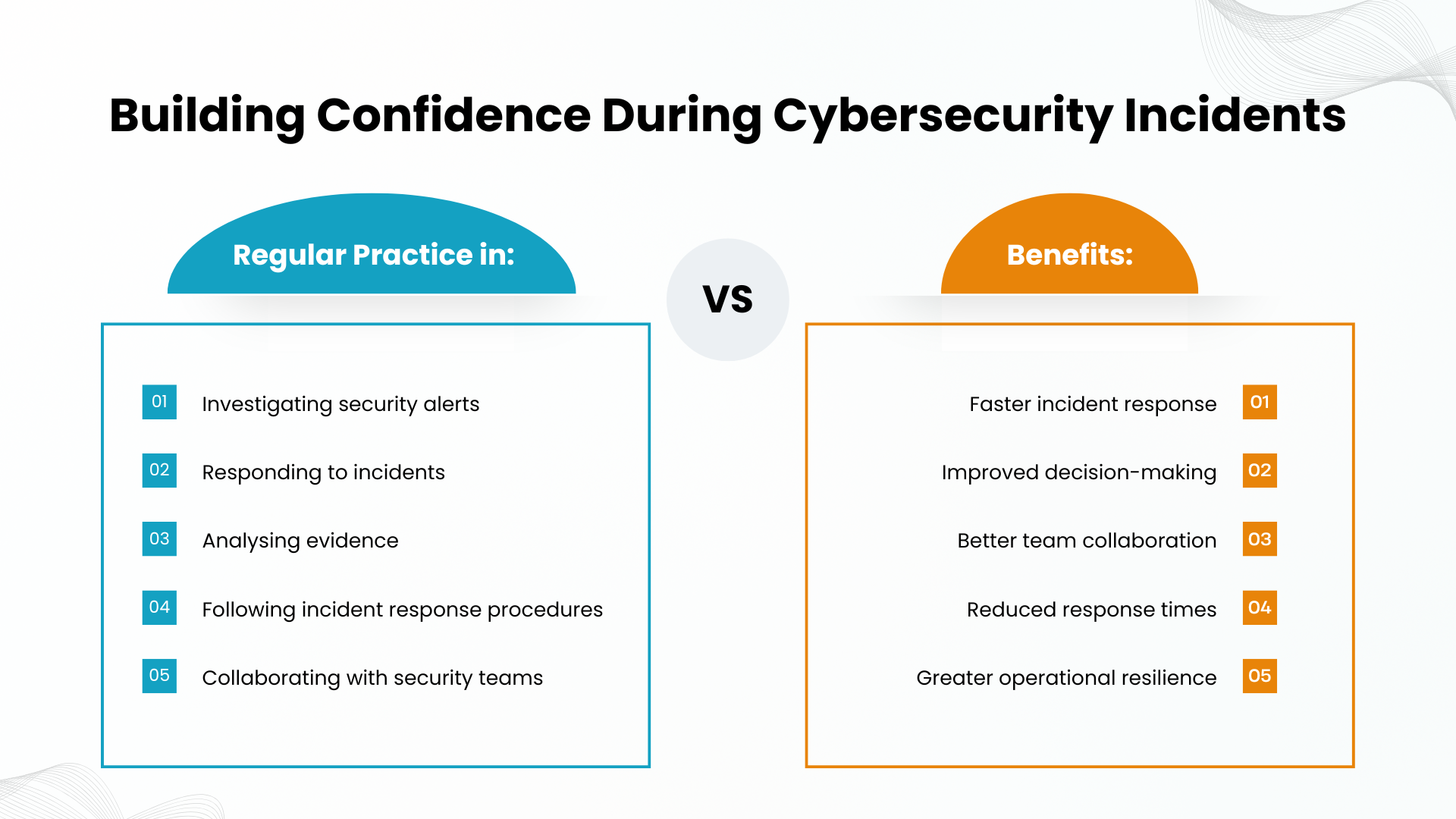
Hands-on cybersecurity training helps build confidence by encouraging regular practice in:
- Investigating security alerts
- Responding to incidents
- Analysing evidence
- Following incident response procedures
- Collaborating with security teams
As professionals gain more practical experience, they become faster, more accurate, and more confident when responding to real incidents.
Benefits include:
- Faster incident response
- Improved decision-making
- Better team collaboration
- Reduced response times
- Greater operational resilience
From a business perspective, cybersecurity training should be viewed as a risk reduction investment, not simply an employee development expense.
Technology alone cannot eliminate cyber risk. Even organisations with advanced security platforms depend on skilled professionals to operate them effectively.
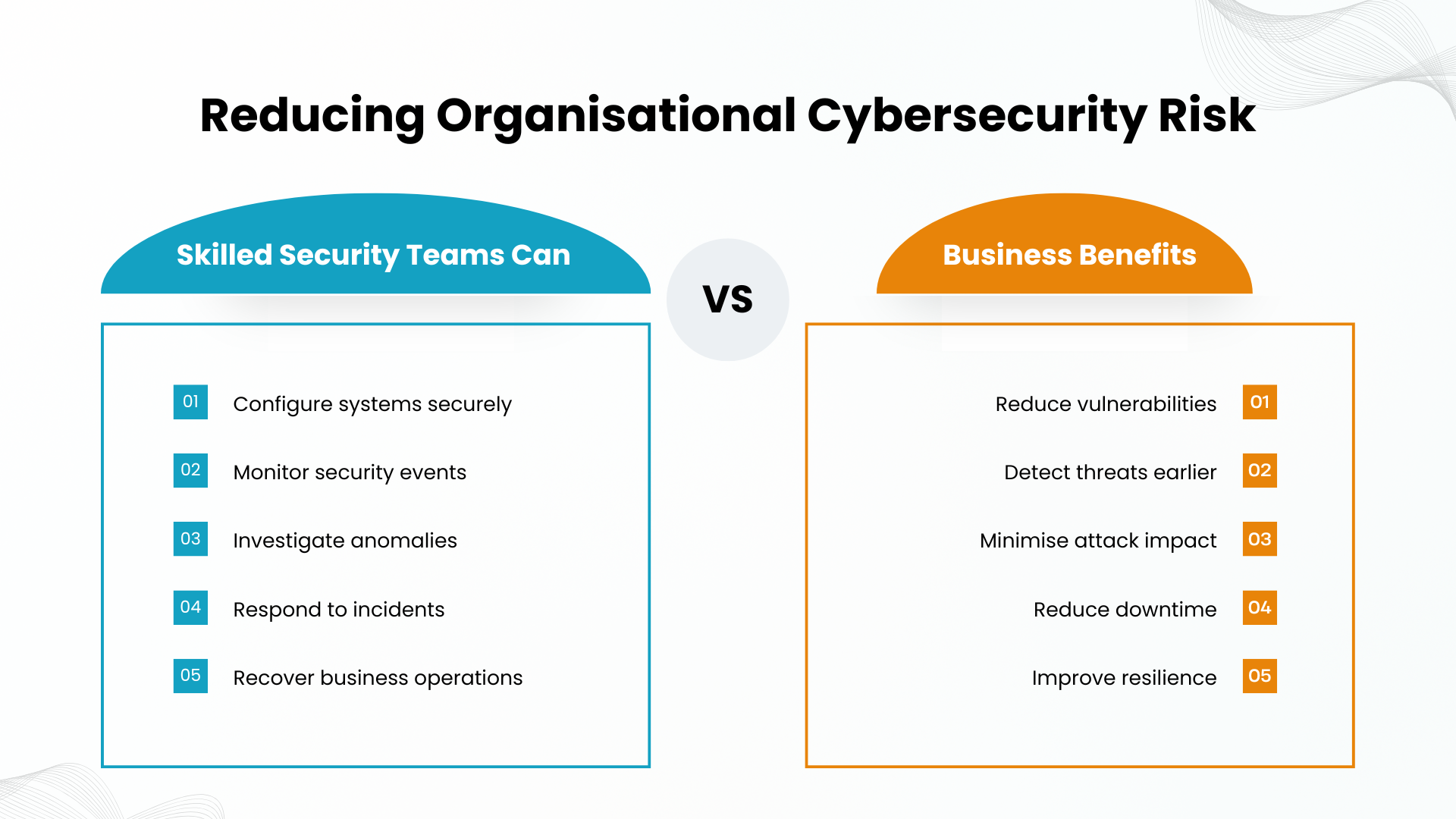
| Skilled Security Teams Can… | Business Benefits |
|---|---|
| Configure systems securely | Reduce vulnerabilities |
| Monitor security events | Detect threats earlier |
| Investigate anomalies | Minimise attack impact |
| Respond to incidents | Reduce downtime |
| Recover business operations | Improve resilience |
Without practical experience, security teams may overlook indicators of compromise or require longer to contain attacks.
Hands-on labs strengthen these capabilities before a real cyber incident occurs.
Maximising Return on Cybersecurity Investments
Many organisations invest significant budgets in:
- Endpoint Detection and Response (EDR)
- SIEM platforms
- Cloud security solutions
- Threat detection tools
- Identity and access management
- Vulnerability management platforms
However, these technologies deliver value only when employees understand how to use them effectively.
Hands-on cybersecurity labs allow professionals to gain practical experience with tools and techniques similar to those used in real environments, helping organisations maximise the return on their existing cybersecurity investments.
Supporting Compliance and Continuous Cybersecurity Improvement
Many regulatory frameworks now require organisations to demonstrate ongoing cybersecurity awareness, competency, and operational readiness.
Hands-on cybersecurity training supports compliance by helping organisations:
- Maintain employee cybersecurity skills
- Practice incident response procedures
- Stay current with emerging threats
- Improve security awareness beyond annual training
- Foster continuous learning across security teams
Instead of treating training as a once-a-year compliance exercise, organisations can build a culture where continuous learning becomes part of everyday cybersecurity operations.
The cybersecurity landscape continues to evolve rapidly.
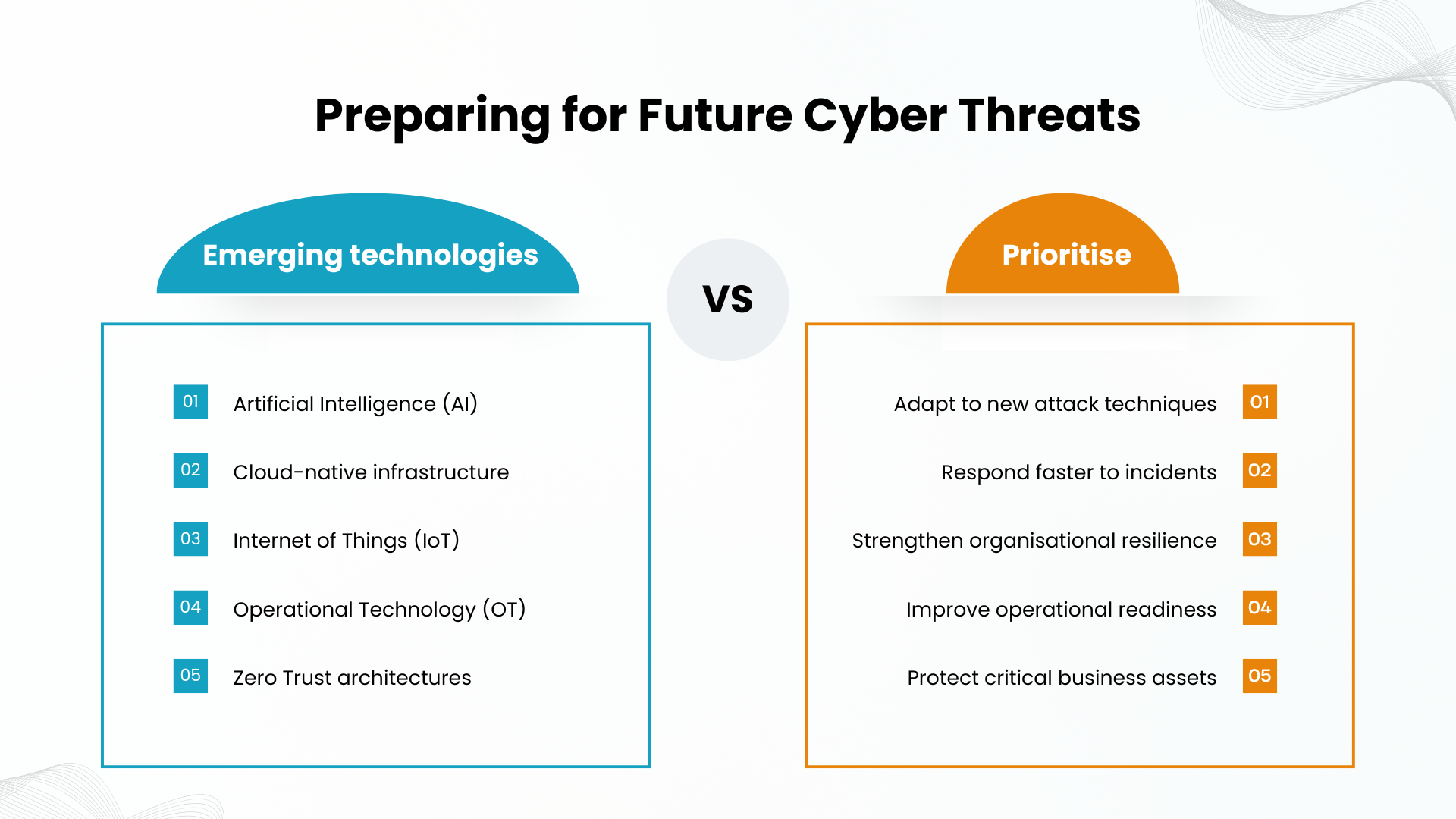
Emerging technologies such as:
- Artificial Intelligence (AI)
- Cloud-native infrastructure
- Internet of Things (IoT)
Operational Technology (OT) - Zero Trust architectures
are changing how organisations defend against increasingly sophisticated cyber threats.
As technology evolves, the workforce responsible for protecting it must evolve as well.
Organisations that prioritise practical cybersecurity training are better positioned to:
- Adapt to new attack techniques
- Respond faster to incidents
- Strengthen organisational resilience
- Improve operational readiness
- Protect critical business assets
Those relying solely on theoretical learning often find themselves reacting to threats rather than preparing for them.
Conclusion
Cybersecurity is fundamentally a practical discipline. While theory provides the foundation, real-world experience develops the skills that matter most when systems, data, and business operations are at risk.
Hands-on cybersecurity labs transform learning into practical capability by allowing professionals to investigate realistic attack scenarios, build confidence, and develop the critical thinking needed to respond effectively under pressure.
For organisations, investing in practical cybersecurity training is more than supporting employee development, it is an investment in stronger security outcomes, operational resilience, business continuity, and long-term cyber readiness.
As cyber threats continue to evolve, the organisations best prepared to defend themselves will be those that ensure their people have not only learned cybersecurity concepts but have also practised applying them in realistic environments.
Ready to Start Your Journey?
Take advantage of HRDC claims and PERKESO EIS training or self-pay with instalment methods at Infosyte.
Contact us for more information on funding and available courses for each funding method.
Check out our ongoing sales and discounts and register for Palo Alto Cybersecurity Courses today.